

PURPLE PROSE
(Gaius Konstantine /Editorial)
I wish whoever came up with the concept of “show don’t tell” were alive and in front of me…so I could strangle them in person.
Did I just show or did I tell?
The answer may be less obvious than it first appears.
What I just did there was both. In plain language I stated a preference, but the framing also revealed my irritation with a piece of advice that gets repeated so often it has started to function more like dogma than guidance. I could have replaced the sentiment with a slow-motion description of hands tightening, color draining from a face, and labored breathing. That would have been more “showing.” It also would have added length without adding meaning.
The real problem is not that showing is bad. The problem is that many writers treat it as an absolute. Sometimes the most effective way to show something is simply to tell it. Other times, elaborate showing adds nothing useful and becomes complexity for its own sake.
Here’s a quieter example from the opening of my own novel:
Growing up I never thought I’d be a thug one day. Come to think of it, I never gave the future much thought at all.
On the surface this is pure telling. There is no sensory detail, no metaphor, and no carefully staged image. Yet the sentence does work. It establishes a voice, sets a tone, and immediately signals the kind of story the reader is in for. Its effectiveness comes from its brevity, not in spite of it. A longer, more “shown” version would not necessarily have been clearer or more engaging; in fact it may have been less effective.
The advice to show rather than tell is useful in moderation, but it has been repeated so often that many writers now default to description even when it slows the story. Describing a desk in detail—the grain of the wood, the carving on the drawer, the exact shade of the finish—is fine if that desk matters to the scene or the character. Doing it for the sake of “showing” is usually a digression. The more time spent on an irrelevant object, the longer the story is delayed.
Style preferences vary, of course. My partner at the Nook enjoys describing even small things in detail; that approach works for her. For other readers (and for other kinds of stories), excessive description can become a barrier. The test is not whether something is shown or told. The test is whether it serves the narrative and maintains momentum.
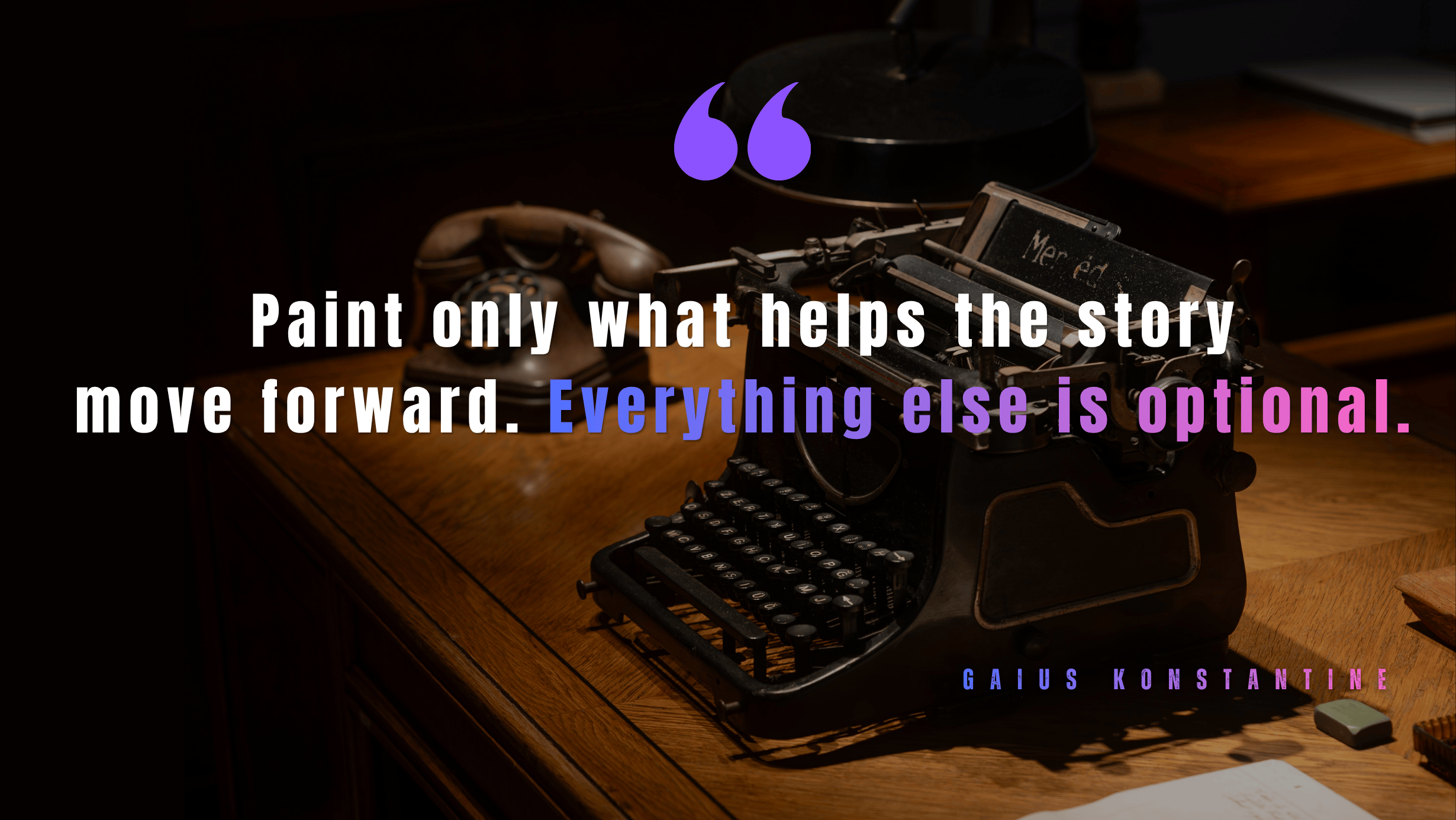
I could go back through my own book and add ten thousand words of carefully rendered trees, concrete, rain like heaven’s tears, and water along a shoreline. The manuscript would be longer and more ornate. It would not be stronger. In that particular story the atmosphere depends on restraint. Different genres and points of view reward different balances. The useful rule is simpler than the one usually repeated: paint only what helps the story move forward. Everything else is optional.
Gaius Konstantine is the author of Fading Away: Dark Bay and a literary critic known for honest, no-nonsense takes on literature. He writes. He critiques. He calls it as he sees it.
Connect with him on X at @GaiusKonstantin.
