

The Mafia Isn’t the Point: Getting Inside CJ Simone’s Head
I’ll be honest, when an author’s bio says “mafia thriller series,” I usually brace myself for a certain kind of book. Slicked-back hair, romanticized violence, a body count standing in for a plot. CJ Simone, author of suspense and dark psychological fiction and the mind behind the Children of the Mob series, isn’t writing that book, and the more I dug into her, the clearer it became that her real subject was never the mob at all. It’s the kids who grew up inside it, and what surviving that does to a person’s mind. Worth noting too, the mafia series is only one piece of what she does. Her catalog also includes The Gallos, a standalone psychological thriller about a girl invited into her wealthy neighbors’ home only to be framed for their abusive father’s murder, Pip and Estella, a gothic historical retelling of Dickens’s Great Expectations told in dual points of view, following two orphans, one raised humble and one raised wealthy but lonely, whose bond gets used as a weapon in someone else’s vengeful plan, and an upcoming gothic thriller, all of it united under what she calls dark psychological fiction meant to offer both thrills and something to actually sit with. That’s the spotlight I want to run today, not a review of one book, but a look at why this particular author keeps circling back to the same dark, family-shaped well.




So, Why Mafia Stories?
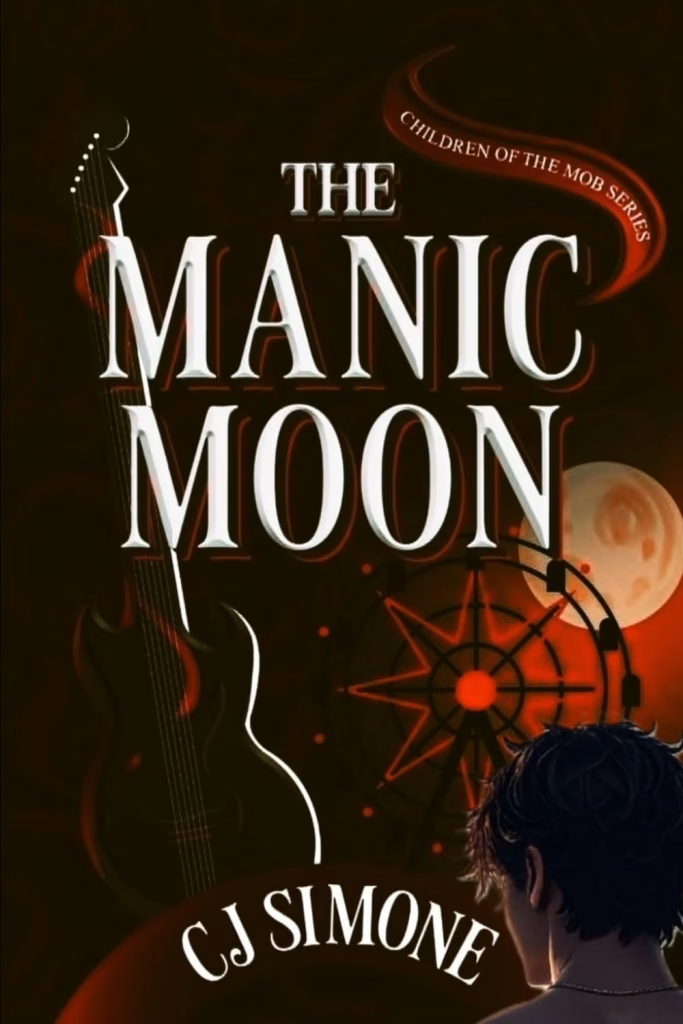
Here’s the thing that surprised me most: Simone didn’t start with mobsters. She started with a character. In her own words, The Manic Mission “started as a character-driven thriller about a young musician w/ his own traumatic past and mental health struggles on a mission to rescue trafficked kids, as a sort of way to draw more attention to the problem of youth trafficking and other forms of abuse (including the often-overlooked male victims).” That’s the whole engine of the book laid out plainly, thriller mechanics wrapped around an issue she actually wanted people to sit with.

The character work was just as deliberate. She told me the hope was “to make it a thrilling story with a highly complex protagonist that readers might initially dismiss as a brat with his troubled and manic tendencies, but one they would come to have a greater understanding of and even come to love by story’s end.” That’s a hard needle to thread, asking readers to write a character off before you convince them not to, and by her own admission it worked better than she expected: “I didn’t expect readers to love Gabe Girodano quite as much as they did, but a look at the reviews shows that love!” Underneath the romance and the danger, though, she’s clear the real aim was bigger than any one character. Her “other goal for the story was to raise awareness and perhaps encourage others to prioritize and address social issues that deserve to be top concerns but often get brushed over.”
Only after Gabe existed did she go looking for who the traffickers should be. As she put it, “being a third generation Italian American and aware that the mafia is currently involved in human trafficking (with some distant mob relatives myself), mobsters were the perfect choice.” Notice that ordering again: the social issue came first, the protagonist came second, and the mafia only showed up once she needed an antagonist that fit both her research and her own family history. It’s also not static. She mentioned that “as the Children of the Mob series progresses, it gets more and more focused on the Italian family’s involvement in crimes,” so the deeper you go into the series, the more the Giordanos themselves move to the center of the story.
The Family Stuff Is Real, Mostly
“Family is huge for me, as it is for most Italians, and my stories are very family focused,” Simone told me, and it shows. There’s romance in these books, plenty of it, angsty and closed-door, but she’s upfront that it’s not really the point. “My focus is often more so on dark family drama and secrets, along with the thrills,” she says, which tells you exactly where the emotional weight of these stories actually sits.
She’s quick, almost protective, to draw a line between that fictional darkness and her own family. “My father, a retired commander, is a good man, nothing like the evil fathers found in the Giordano or Gallo families,” she says. It was her father’s own father who had the mob connections and the abuse in his past, and by Simone’s account, her father broke that cycle rather than continuing it: “he broke the cycle and never raised a hand to me or my siblings.” If anything, she says he swung the other way entirely, joking that he “leaned toward permissive parenting” and guessing he “must’ve saved any directives for those he was commanding and not his kids.” She hasn’t lived with him since the fourth grade, and by her account, they still get along well.
Her connection to the wider Italian side of the family was more distant, geographically at least. Her parents’ divorce and several states of separation kept her apart from relatives in New Jersey for much of her life, though she still got glimpses of it, elaborate home gardens, spaghetti and other meals made entirely from scratch, and darker details about family history passed along by her father’s side. It was her mother, notably, who told her about the mob relations and friends who’d offered protection if the family ever needed it, an offer her mother graciously declined.
What stuck around despite the distance was harder to pin down than any single memory. “Their influence, both socially and even genetically, was very much present,” she says, “rapid and lively talking, hand gestures, and passion are the norm.” One brother-in-law, she jokes, refers to what the family considers a totally normal conversation as being “all riled up.” And growing up, whenever she was testing her mother’s patience, she’d hear how much she took after her father. She doesn’t dispute it. “I did inherit a very strong-willed streak from him,” she admits, “thankfully balanced by being a compassionate person.”
Even her characters’ religion is doing more work than it might first appear. Most Italians are Catholic, and although Simone describes herself as a nondenominational follower of Christ personally, she kept the Giordanos true to type. Their faith isn’t just background color, either. Their “attendance at midnight mass on Christmas Eve became extremely useful and important to the plot,” she explains, placing innocent neighbors in danger right alongside protagonist Gabe as he slips out of mass at midnight to play a kind of Robin Hood Santa to street kids, just before a planned rescue of trafficked youth.
THE RELATIVES


The Mental Health Thread Running Through Everything
If there’s one thing I’d tell you to pay attention to across her catalog, it’s this. Mental health advocacy is central to every book Simone has written, mafia setting or not, and it shows up clearly even outside the Children of the Mob world, in her standalone Great Expectations retelling, Pip and Estella. The original novel touches on mental health too, she points out, though it “didn’t necessarily label it that way back when the original was written.” What’s different in her version is emphasis: “it’s more front and center in my retelling,” she says, and in Pip and Estella specifically, some readers have told her the shift ends up “greatly humanizing the characters.” Still, it’s the Children of the Mob series where the advocacy hits hardest, because those plots are essentially driven by Gabe Giordano’s bipolar disorder and trauma, not just decorated by it. He’s a character who, by her own description, tries hard to be a hero but often ends up doing more harm than good as a self-described “wrecking ball.” That’s not the whole picture, though. “It’s his heart that readers seem to connect with,” she says, “and sometimes he really can shine as a true hero.” The disorder shapes his choices, but it doesn’t define whether he’s worth rooting for.
Ask her how she manages to keep that advocacy alive inside such high-stakes plots, and she’ll tell you it all comes back to one thing. “Everything starts with character for me, and a very deep understanding and development of the characters, so the stakes then naturally become very personal and intimate even while they’re high,” she says. That’s not incidental, either. “The plots themselves are born out of the characters” in her stories, she explains, whether the fear circles around sanity and what someone’s capable of, the intense pain of family betrayal, or corruption being fought both without and within. It’s a detail reviewers apparently pick up on too. Readers, she notes, “worry as much about the characters’ psychological well-being as the life and death danger.”
What makes this feel earned rather than performative is that she’s not writing from a distance. Within her own family and many of her close relationships, she says, “there exists a lot of both mental health struggles and trauma,” bipolar disorder chief among them, alongside anxiety disorders including OCD, depression, ADHD, and others. “My personal struggles definitely make it easier to write naturally,” she says. She’s spent most of her life masking, high-functioning enough that it worked, but one of her stated goals now is “to decrease the stigma surrounding mental health and to be more forthcoming about it, so others may also feel comfortable doing so.” That’s not a marketing angle. That’s someone using fiction as the more comfortable door into a harder conversation.
There’s a professional layer underneath it too. She’s worked with youth in runaway shelters, group homes, and juvenile detention, and has had her own research published on interpersonal violence, including partner and sibling abuse, under a different name. None of that is invented. It’s just filtered through fiction instead of case files.
That professional and personal knowledge shows up most clearly in a detail she’s clearly thought hard about: male victims get real weight in her work, not just female ones, in part because she’s known so many both personally and professionally. “They often go overlooked,” she says, “but it’s much more common than most people realize.” It’s why there’s a Children of the Mob storyline built around Gabe Giordano’s abusive music manager and girlfriend, which she calls a rare portrayal of that kind of violence in fiction. Given how often the genre skips past male victimization entirely, that alone sets her work apart.


Where the Real Fight Happens
If you want grit and danger but you’re the reader who actually needs to feel something for the people underneath the plot, this sounds like your lane. Simone is explicit that she’s not interested in romanticizing power and violence the way a lot of mafia fiction does. Part of that comes down to training as much as instinct; she credits her own psychology background, along with her focus on the children of mobsters, Gabe and Kallie Giordano, who spend the series fighting their own family, and in Gabe’s case, fighting himself, rather than the mobsters getting glorified as the show’s main draw. As she puts it, readers get “real and very personal struggles against powerful mafia players, corrupt power” instead, and plenty of angsty, closed-door romance along the way too. That romance-plus-darkness combination isn’t confined to the Giordanos, either. Swap the mob for old money and you land in The Gallos, where a girl taken in by the wealthy siblings next door slowly realizes their hospitality has a motive, and where the line between victim and suspect gets blurrier the closer she looks. Same ingredients, different family: corrupt power, a house full of secrets, and a romance that complicates everything rather than resolving it. It’s the same instinct running through both books, mob family or not, the corrupt power and the romance are never separate ingredients, they’re the same story. Family drama and psychological stakes are the throughline, which tracks with how Simone describes herself: an author of suspense and dark psychological fiction, mafia setting or not.
One practical note if trafficking storylines are hard for you specifically: The Manic Edge is the entry point for readers who want to stay in her world without that particular thread. Otherwise, start where the series does, with The Manic Mission, which one reviewer described as a book where, “if you can handle the shadows,” you’ll get “a story that lingers long after the final page.” And if you’re the kind of reader who doesn’t read in order anyway, Simone says that’s fine too. All the books work as standalones, and she’s made a point of keeping spoilers to a minimum for anyone who wanders in out of sequence.
The Person Behind the Pen Name
What stands out most, honestly, isn’t any single plot detail. It’s how unbothered Simone seems about admitting her process isn’t tidy. Asked how she manages to weave family loyalty, trauma, and power dynamics together so naturally, she doesn’t offer some polished craft-talk answer. “My process is a mystery even to me, rather than something neat and easily definable,” she says. For a writer whose books get praised for how deeply developed her characters are, that’s oddly reassuring. It’s not a formula. It’s intuition, professional experience, and a fair amount of her own life, all running together.
That’s really the throughline here. The mafia is the setting, the trafficking plotlines are the hook, but the actual engine of Simone’s work is a woman who’s spent time both living through mental health struggles and professionally supporting kids who did too, now finally writing about it in the open. If mafia fiction usually leaves you cold, that’s likely the reason this might not. There’s a real person underneath the shadows, and she’s not hiding from them anymore.

Justine Castellon is a brand strategist with an innate ability to weave compelling narratives. She seamlessly blends her professional insight with her passion for literature. Her literary works include romantic drama novels—Four Seasons, The Last Snowfall, Gnight Sara / ‘Night Heck, and I Love You, Sunday Sunset. With her ability to tell stories that linger long after the last word, Justine leaves a mark not only in the world of branding but also in the hearts of her readers.
www.justcastellon.com


One thought on “Spotlight: C.J. Simone”