

I Didn’t Expect a Book About Demons to Be This Much About Fathers
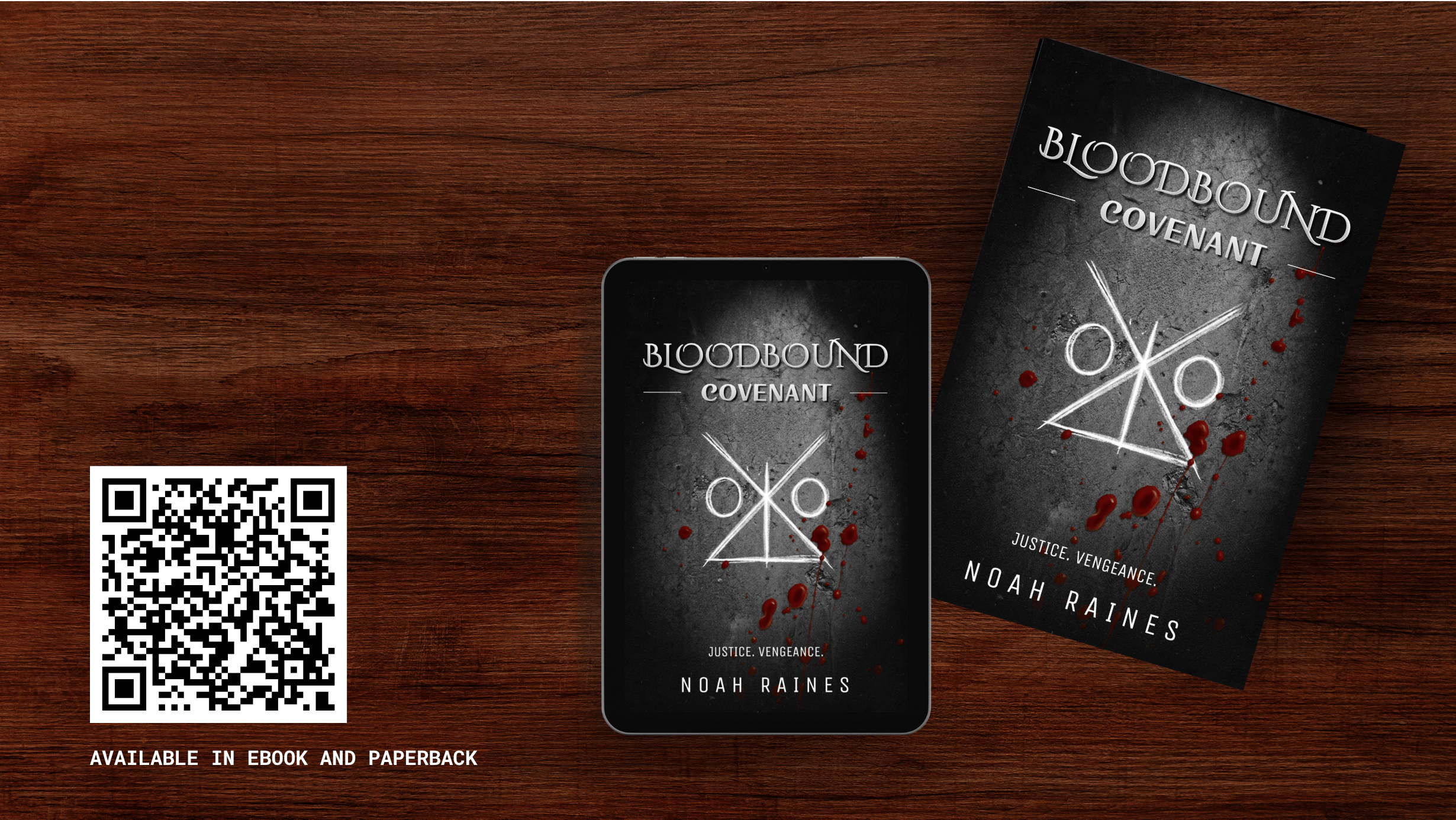
Noah Raines survived the odds, woke up at 3 a.m. with a story, and turned it into Bloodbound: Covenant, a ’90s supernatural mystery that kicks off a six-book saga.
(By Justine Castellon / for Just Reading Nook)
Have you ever picked up a book and then found out the story behind it was almost as wild as the story inside it? That’s what happened to me with Bloodbound: Covenant, Book One of Noah Raines’s Bloodbound Saga. On the page, it’s a supernatural thriller set in Pasadena in the fall of 1996, packed with angels, ancient sigils, and a cult with a genuinely excellent name. Off the page, it’s a book that was never supposed to exist, written by a man who, by his own account, was never supposed to survive long enough to write it.
I’ll get to that story. I promise. But first, let’s talk about the book, because it deserves to be met on its own terms..
So, What’s It About?
Sofia Vega is sixteen, a student at Pasadena High, and she has never stopped thinking about her father. Diego Vega was an LAPD detective who died nine years earlier in what everyone calls a routine gang incident. Sofia has grown up with that explanation, a photograph on the mantel, a rosary, and recurring dreams that won’t let her go. Then, in a school restroom, a girl with empty black eyes corners her, mutters a cryptic prophecy about her father’s blood, and collapses on the floor. Just like that, the official version of Diego Vega’s death starts to crack.
Enter Caleb Holt, seventeen, a ranch hand from Winnett, Montana, who trades fence posts for Pasadena High when he moves in with his mother, Kathy, a trauma nurse. He’s polite, a little old-fashioned, quotes his grandfather in AP U.S. History, and is very clearly stronger than any teenage boy has a right to be. (There is a basketball incident in gym class. The basketball does not survive.) The first time Sofia grabs his arm, pretending he’s her boyfriend to shake off some men harassing her on the sidewalk, something hums between them that neither of them can explain.
Rounding out the trio is Ava Thompson, Sofia’s best friend, the kind of sharp, research-obsessed teenager who can turn a stack of store receipts into a corporate paper trail, and who will absolutely break into the guidance counselor’s computer if it gets her an answer. I loved her immediately. Guiding them is Father Elias Torres of St. Andrew Church, a priest who knows far more than any parish priest should about Enochian script, Solomonic seals, and the things that crawl out of old books.
What they uncover, piece by piece, is that Diego didn’t die in a gang shooting. He died protecting a child from something much darker, and what he uncovered is still out there, scrawled in ancient sigils across his hidden notebook and the sketchbook of a boy who can’t stop drawing them. And the people responsible for her father’s death never really went away. They call themselves the Covenant of the Fallen Eyes, and they’ve been busy. A shadowy company called Erebus Holdings, LLC has been quietly buying up historic properties and mission buildings across Los Angeles, and it is not because they love the architecture.
That’s all I’m going to tell you, and honestly, it’s more than the author likes to say. Raines admitted to me that he was so guarded with the plot, “and still am really,” that it’s hard to tell people what the book is even about. He did give me permission to tease the lore, though, and his own tease is the best one I’ve got: “By the end of book 1, you only just know what story you’re in… but have no idea how big it is.”

The Story Behind the Story
Here’s the part that stopped me in my tracks.
Raines began writing the Bloodbound Saga while recovering from a serious medical crisis, one he says he simply should not have survived. “My friends and family of course know the full story here, but essentially I should be dead,” he told me. He walked me through the numbers: a 17 percent immediate survival rate, and then the odds halving again at thirty days, again at six months, and again at one year. He jokes that he made it because he’s “so awesome.” The real reasons, he says, were mostly his age (“I’m not that ancient yet”) and his attitude. “I just wasn’t ready to consider that I wasn’t going to be completely ok and do everything I did before.”
What he didn’t expect was what recovery would do to his imagination. He describes a rewiring of the brain that, from the outside, seemed minor, followed by a flood of creativity he hadn’t felt since junior high. Almost every day, usually around 3 a.m., he would wake up “completely stone cold sober awake, with this story in my head.” He started researching. Then he started mapping it all out on a Miro board, a digital whiteboard, for weeks and weeks. Then, finally, he started writing. Somewhere along the way, the outline outgrew a single book, and he realized he had the bones of a six-book saga.
“Next thing I knew the first book was drafted… then the second… and a third and I realized holy crap I might actually write this entire thing.”
I asked him how that brush with mortality shaped Sofia and Caleb, two kids who discover they were made for something far bigger than they ever asked for. His answer is, I think, the key to the whole book. “I just knew there must be something else I was still here to do. I wasn’t supposed to be alive.” He likes to tell his wife it’s because God has bigger plans for him, so don’t mess with him. But joking aside, he said, “that’s how it felt. So there being a bigger plan for these characters (more than they ever knew, or desired) must be influenced by that.”
Once you know that, you can’t unsee it. This is a book about strength that shows up when someone else needs protecting. The courage in these kids doesn’t come from ambition or training. It shows up when someone who can’t defend themselves needs them. That isn’t an accident. That’s a writer who knows what it feels like to be handed a second chance and spend every 3 a.m. wondering what it’s for.
One more thing worth saying: the book you’ll read isn’t the first draft. Raines is upfront that he was learning as he went, and that beta readers and editorial feedback pushed him into a lot of changes. I appreciate an author who says that out loud.
Why 1996? (And Why the Chapter Titles Made Me Grin)
I was curious why Raines set the story in autumn 1996, because the era does so much work for the mystery. No smartphones. No Google. Whether it’s Ava sifting through carbon-copy receipts or Sofia scrolling through library microfiche reels, the trio has to rely on pure investigative grit rather than instant search engines. If Sofia needs to find her father’s old partner, she has to actually track him down. Information moves slowly, and slow information is wonderful for suspense.
I expected a grand strategy. Instead, I got the most honest answer of the whole interview. “I would love to tell you that it was all a strategy and there was a bigger rhyme or reason to it… but in reality, it was because I knew I could NOT write realistic teens from eras other than my own,” he said. “I graduated in 1996. So I wrote what I knew.” He thinks it’s more fun that way, and he added that the saga ages with its characters. Book Two crosses the millennium.
And can I just say, the commitment to the era is a delight. The chapters are titled after songs and pop touchstones, and if you came of age in the ’90s, the table of contents reads like a mixtape: “Nobody Knows,” “Ironic,” “Black Hole Sun,” “Bullet with Butterfly Wings,” “One Headlight,” “Don’t Speak,” “Counting Blue Cars,” even “The X Files.” A flashback to 1970 gets “Run Through the Jungle,” which made me smile. There are Pac-Man ties, a Galaga mouse pad, a lowrider, a school dance called the Turkey Tussle, and a Montana boy with a guitar singing Springsteen. It’s nostalgic without being a gimmick, because the pre-digital world genuinely holds up the plot.
Okay, But What About the Lore?
This is where Bloodbound: Covenant gets ambitious. Raines blends grounded high school life with ancient Enochian sigils and Solomonic history, all surfacing in a dead detective’s hidden notebook and a troubled teen’s sketchbook. There’s an interlude that reaches back thousands of years to the ancient world, and another that drops us into a covert operation in Laos in 1970. It’s a big, layered mythology, and it’s clear he did his homework.
So how did he research it all? “Oh my. I think I just love learning,” he said. Being on medical leave gave him time to read, research, and map out ideas and alternate histories. Part of the core mythology came from a theological conversation with his son, which he describes as “painted with my own nerdy love of conspiracy and weird urban myths.” He also credits The Why Files and its host, AJ Gentile, as part of the creative soup.
Honestly? That tracks. The book has that same late-night, rabbit-hole energy: the feeling of following one strange symbol down a rabbit hole and realizing it goes much, much deeper than you thought.
The Ghosts Our Parents Leave Behind
Strip away the demons and the sigils, and Bloodbound: Covenant is about kids inheriting things they never asked for: secrets, grief, bloodlines, unfinished fights. Sofia is quite literally living with the consequences of her father’s last act. Her mother, Isabel, who teaches calculus at Sofia’s own school, has spent years keeping Diego’s investigation boxed up in the attic to protect her daughter. Caleb’s family has history he doesn’t know about yet. And Alex Saliba, a troubled senior who was eight years old the night Diego died, still fills his sketchbook with symbols he doesn’t understand and can’t stop drawing.
I asked Raines what draws him to the way the past echoes into the present. “Probably getting old myself,” he said. “Wrestling with mortality. Watching mentor after mentor of mine pass away. The people that shaped me were slipping away and I was wondering what I was leaving behind.”
That answer hit me hard, because it reframes the whole book. The parents in this story, Diego most of all, are defined by what they leave in their wake. The kids are defined by what they choose to do with it. And I loved that the adults here aren’t useless background furniture, which is rarer in YA than it should be. A retired detective, a priest, a fierce widowed mom: the grown-ups show up.
Who Should Pick This Up?
If you love supernatural YA or crossover fiction with a real mystery at its core, this is for you. Fans of Cassandra Clare’s hidden-world urban fantasy will feel right at home, and if you grew up on the monster-of-the-week teamwork of Buffy the Vampire Slayer or the angels-and-demons scaffolding of Supernatural, you’ll recognize the DNA. If you’re a ’90s kid, add a full star for nostalgia alone.
A few honest caveats. This book takes its mythology seriously, and there is a lot of it: Enochian scripts, Goetic demons, Latin and Hebrew terms, angelic hierarchies. If you like your paranormal fiction light on lore, you’ll need to lean in and trust the story. It also gets genuinely dark and creepy in places, with occult rituals, possession, and at least one full-on horror set piece involving a morgue, which is all I’ll say about that. And faith is woven into the fabric of the book, from rosaries to Latin rites, so expect Catholic tradition to be part of the arsenal, not just set dressing.
Last caveat, and the author said it himself: this is Book One of a six-book saga. The immediate threat in Pasadena gets its reckoning, but the bigger war is only beginning. If you need every thread tied off by the final page, know going in that Raines is playing a long game.
Okay, But How’s the Writing?
The heart of this book is the trio, and Raines nails their dynamic. Sofia is guarded and fierce, Caleb is steady and decent in a way that feels earned rather than saccharine, and Ava is the brain who refuses to be left on the sidelines. Their banter feels like actual teenagers talking, which tracks with an author who wrote the high school he lived through.
I also loved the cultural texture of the Vega household. Isabel’s kitchen, huevos rancheros for the new boy, churros on a Saturday morning, and chapter titles like “Soy Tu Madre” and “Mi Madre Es Tu Madre.” It makes Sofia’s world feel lived-in and specific, not generic suburbia.
My gripes are the kind that come with ambition. The cast is big, and between the present-day story and the flashbacks across time, the momentum occasionally pauses while the world gets built. Some of the mythology arrives through Father Elias explaining it, and while I enjoyed him, a few of those scenes lean more lecture than scene. And if you’re here mainly for romance, Sofia and Caleb’s connection is a slow, simmering build rather than the main event. None of that is a deal-breaker. It’s a first book laying a lot of track for five more.
So, Should You Read It?
Is Bloodbound: Covenant worth your time? Yes, absolutely. And I’m not the only one who thinks so: Gaius Konstantine gave it a five-star review for the Nook. It’s a big, lore-heavy opener that sometimes slows down to build its world, and it ends by opening doors rather than closing them. But it’s also a mystery with real heart, a love letter to the last pre-internet generation of teenagers, and a story about what we owe the people who protected us. Knowing it came from a writer who beat terrible odds and woke up at 3 a.m. with a story he couldn’t ignore only makes it land harder.
When I asked Raines what he hopes readers feel when they turn the final page, he didn’t hedge. “The story is global,” he said. Book Two doesn’t stay in Pasadena, and Sofia and Caleb don’t stay teenagers. “I hope readers are hungry for the second book when they hit the end of book 1.”
Consider it a highly recommended read, especially if you love a slow-building supernatural saga you can sink into. Start here, settle in, and get ready. If he’s right about how big this story gets, we’re only standing at the front door.
Read: The Darkness Never Sleeps, But Neither Does the Light. Bloodbound Covenant by Noah Rains

Justine Castellon is a brand strategist with an innate ability to weave compelling narratives. She seamlessly blends her professional insight with her passion for literature. Her literary works include romantic drama novels—Four Seasons, The Last Snowfall, Gnight Sara / ‘Night Heck, I Love You, Sunday Sunset.and The Runaway Prince. With her ability to tell stories that linger long after the last word, Justine leaves a mark not only in the world of branding but also in the hearts of her readers.
www.justcastellon.com


