

The Writer Who Calls Himself Immortal: An Author Spotlight on Timothy Robare
I asked Timothy Robare how old he is. His answer was one word: immortal.
I’ll be honest, I didn’t expect that to be the most normal thing he said in our conversation. This is a man who plays basketball three times a week, climbs mountains, practices both Buddhism and Christianity, and once turned a book cover he liked into an entire fantasy novel just to see if he could. By the time we got to talking about his writing process, “immortal” felt less like a dodge and more like a fair summary of a guy who refuses to sit still long enough to be defined by a number.
Robare writes across genres the way some people collect passport stamps. He has a gritty, humor-laced action series. A more traditional good-versus-evil fantasy. A character-driven novella. And poetry, which he calls his “main squeeze.” That range alone makes him worth a closer look. But it’s the story behind the range, how a kid who couldn’t hear or speak for years of his childhood ended up building an entire literary life out of words, that makes him worth sitting with.

So, What Does He Actually Write?
Ask Robare to describe his catalog, and he doesn’t give you a tidy elevator pitch. He gives you a map.
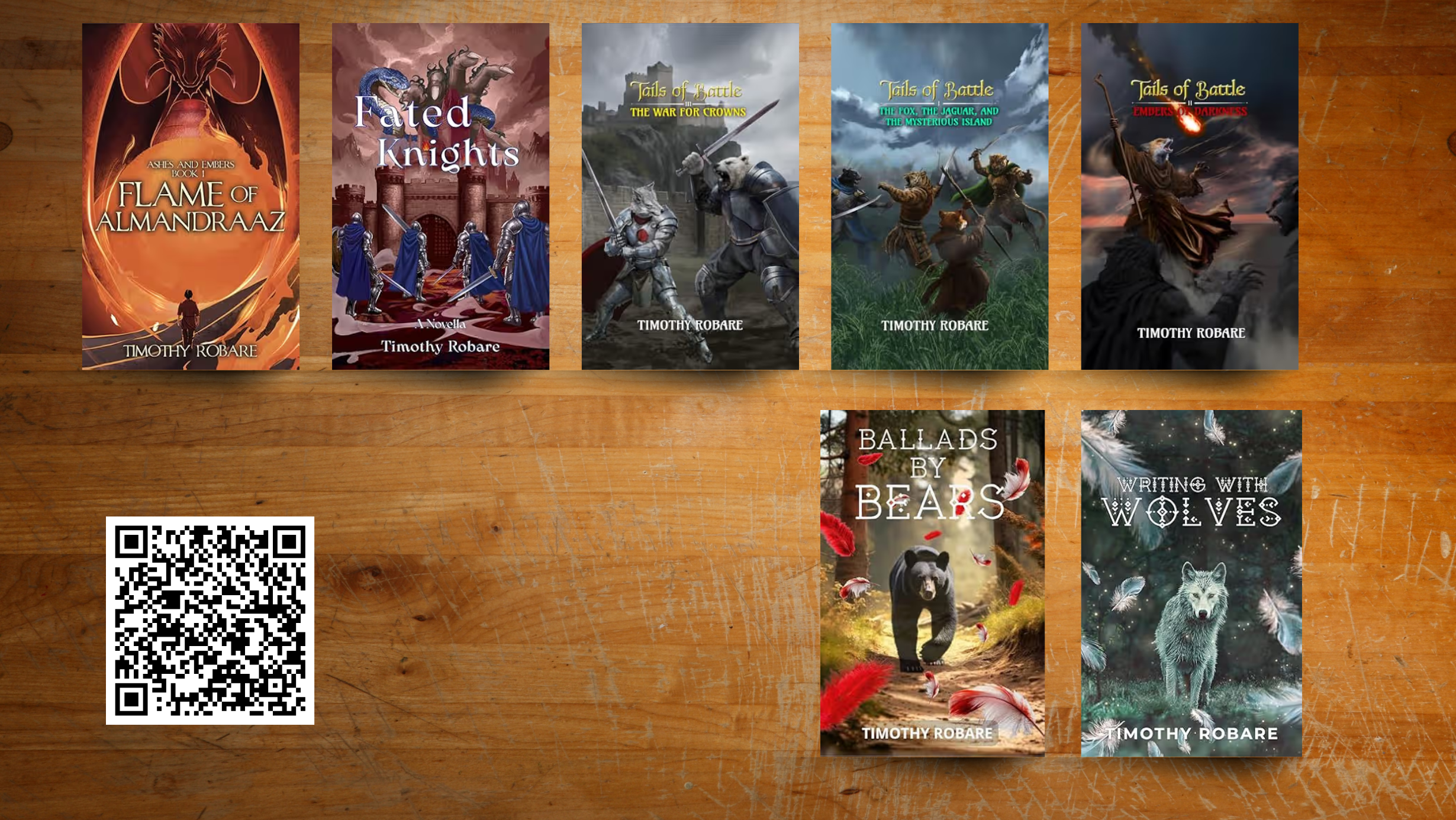
There’s Tails of Battle, which he describes as starting dark and moving toward the light, built for readers who want “action, a bit of gore, and also humor.” Then there’s Flame of Almandraaz, a more classical good-versus-evil story that he says is “not so R-rated,” in contrast to the battle series. There’s Fated Knights, a novella he describes as action and character-driven. And running underneath all of it, his poetry, which he writes for “various muses” and considers open to anyone, no genre preference required.
What struck me is how differently these books came to exist. Tails of Battle wasn’t born from a plan, it came out of necessity. Robare started writing it after university, while working a gas station job, mostly as a way to get things out of his head and onto a page. There’s something almost clinical about that origin story, a man clocking out of a shift job and going home to bleed dark humor and battle scenes onto the page because he needed somewhere to put whatever he was carrying.
Flame of Almandraaz started somewhere stranger, and honestly more fun. He bought a book cover he liked and built an entire story around it, on a dare to himself. No outline, no concept, just an image he liked enough to reverse-engineer a novel from. One book is emotional excavation. The other is a creative challenge he handed himself for sport. Both are still, somehow, recognizably his, and that’s the throughline worth noticing. Whether the starting point was trauma or a random image file, Robare’s instinct is the same: turn it into a story and see what happens.


Who Should Be Reading Him?
Robare is refreshingly specific about who his books are for, which I appreciate as someone who talks to a lot of authors who insist their work is “for everyone.”
If you like dark themes cut with humor and intense battle sequences, Tails of Battle is your book. If you want good versus evil without the grit, something character-driven that he genuinely believes works for “all ages realistically,” that’s Flame of Almandraaz. If you’re drawn to action wrapped around strong characters, he points you toward Fated Knights. And if you just like poetry, full stop, he wants you in his poetry collections, no other qualifications needed.
It’s a smart way to think about a body of work. Not every reader wants the same Robare. He’s built enough doors that most people can find one that fits.


The Man Behind the Pages
Here’s where the interview stopped feeling like a standard author Q&A and started feeling like something more honest.
Robare grew up unable to hear or speak until a series of surgeries changed that. Writing, he told me, was always the more natural way for him to communicate, long before speech was an option. That early history explains a lot about why storytelling isn’t a hobby for him, it’s closer to a native language. He started where a lot of us started: fan fiction. Dragon Ball Z first, then Redwall. Not literary pedigree, just a kid finding the version of writing that fit him.
College nearly took him somewhere else entirely. Robare went in leaning toward athletics and genetics, not literature. It was an English 102 professor who changed the trajectory, telling him he was writing at a level far above anyone else she’d read at the university. He switched his major on the strength of that one conversation. He’s self-aware enough to laugh about it now, calling it “a lot of smoke blown up my rear,” but he also doesn’t pretend it didn’t work. It reshaped his entire path.
He’s candid, too, about how his mental health has shaped his writing over time. He described starting out in “a very dark space,” carrying real trauma from childhood, and said that as he’s healed over the years, his writing has shifted with him, moving toward more peace. That’s not a small thing for an author to say plainly, and I didn’t want to gloss over it. The tonal range across his books, dark and gory in one series, gentler and more classical in another, starts to make a lot more sense once you know that.
As for a pen name, he doesn’t use one, and the reason is almost sweet. He told me he wished he had gone the pen name route, but he wrote under his own name hoping his old professors and teachers would eventually find his work and be proud. That’s not the answer of someone chasing anonymity. That’s the answer of someone still writing, in part, for the people who first told him he was good at it.
Outside the page, Robare’s life reads like a list of things most of us put on a vision board and never do. Basketball two to three times a week. Workouts five days a week. Mountain climbing. Tennis. A practice that blends Buddhism and Christianity, two traditions that don’t often get mentioned in the same sentence, let alone the same daily life. Travel that he frames not just as sightseeing but as a way of exploring his own interior life. It’s a physically and spiritually restless existence, and I don’t think that’s separate from the writing. It feels like the same engine.
There’s a version of this profile where all of that reads as a highlight reel, the kind of curated list an author gives a journalist to sound interesting. But paired with everything else Robare told me, about the trauma, the healing, the years of learning to sit with his own mind, it reads more like evidence. A person who spent part of his childhood without a voice at all has clearly decided, as an adult, to fill every available hour with movement, discipline, and searching. Writing is just one more form that search takes.


How It All Started
I asked Robare if he always knew he wanted to write, or if it found him along the way. His answer split the difference. He’d always loved writing, enough that he made money in college writing other students’ papers and poems. But the idea of writing as an identity, rather than a skill, didn’t arrive until that English 102 professor pointed it out to him. Before that, genetics was the plan. After that, it wasn’t.
He’s not precious about the shift. He describes it plainly: she altered his life, and he switched majors hoping to learn and grow from it. No dramatic epiphany, just a professor’s blunt observation landing at the right moment.
The Surprising Part
When I asked what might surprise or inspire readers about his life or process, Robare laughed off the inspiring part entirely, “nothing,” before immediately proving himself wrong on the surprising part.
His process, by his own description, is a mess. No outline, no roadmap. He lets the story take itself wherever it wants to go, and he genuinely enjoys the ride, flaws and all. “To plan, for me, is not to live,” he told me. “To live is to let it flow like the river.” It’s the kind of line that sounds like it belongs in one of his poems, and honestly, it might.
That river metaphor is probably the most useful key to Robare as a writer. He’s not building outlines, he’s following momentum, the same way he moves through a basketball game or up the side of a mountain, reacting, adjusting, staying loose. It’s not a method most craft books would recommend. It’s also, apparently, exactly how a kid who once had no words at all decided he was going to spend his life using every single one of them.
If you’re the kind of reader who wants stories that came from somewhere real, dark humor sitting right next to genuine peace, chaos sitting right next to control, Timothy Robare’s catalog is worth your time. Start wherever calls to you. He built enough doors on purpose.

Justine Castellon is a brand strategist with an innate ability to weave compelling narratives. She seamlessly blends her professional insight with her passion for literature. Her literary works include romantic drama novels—Four Seasons, The Last Snowfall, Gnight Sara / ‘Night Heck, and I Love You, Sunday Sunset. With her ability to tell stories that linger long after the last word, Justine leaves a mark not only in the world of branding but also in the hearts of her readers.
www.justcastellon.com


