

Unmasking the Heartbreaking Comedy: A Feature on Gary Got Goosed
Heads up: this is a deep-dive feature, not a spoiler-free review, and discusses major plot points.
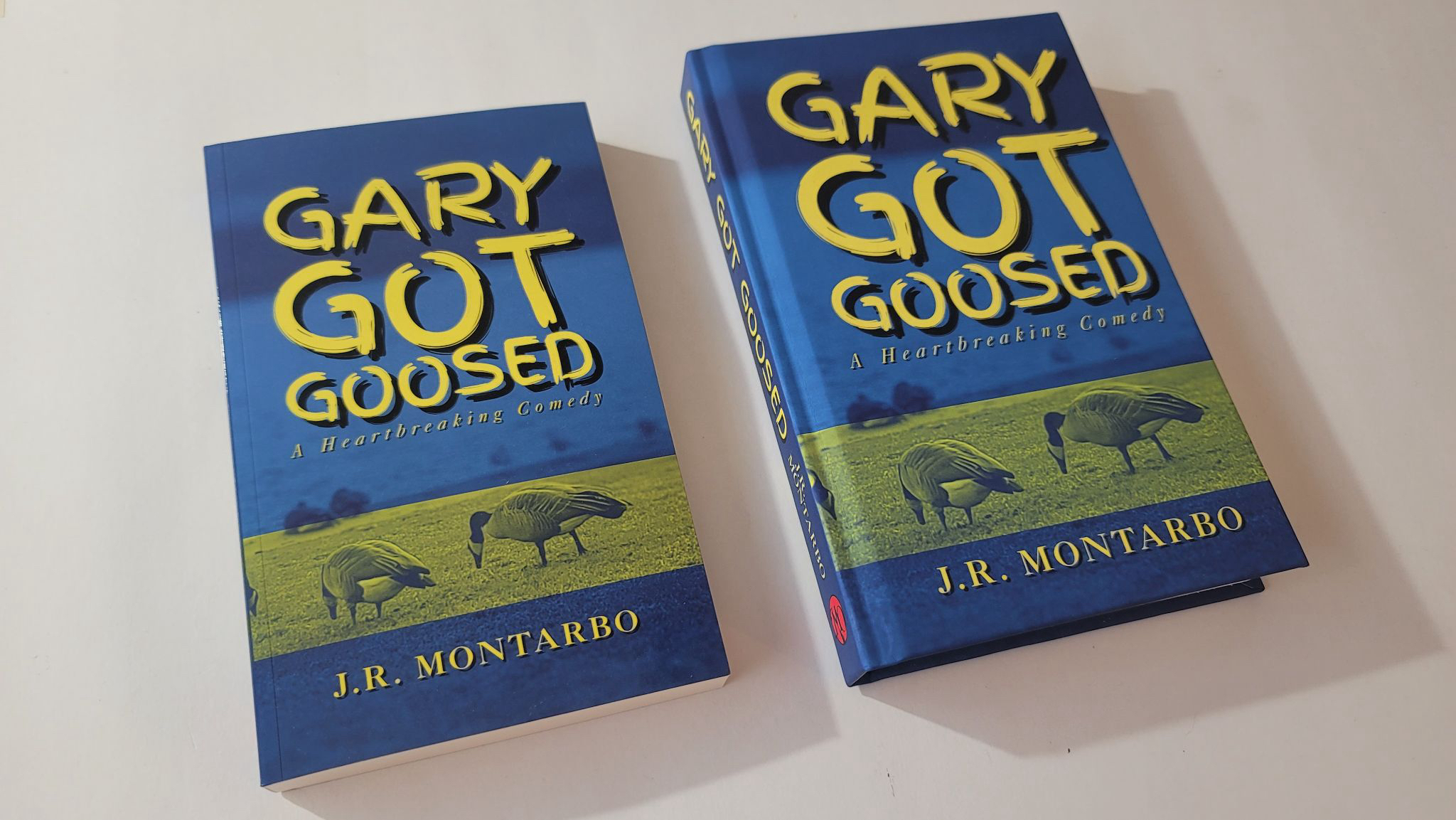
(By Justine Castellon / for Just Reading Nook) I went into Gary Got Goosed expecting a light, funny read about an awkward guy having a bad week. What I got was that, yes, but also a gut-punch of a story that snuck up on me and hit harder than I was ready for. J.R. Montarbo’s debut novel follows Gary Gander, a forty-year-old pizza delivery driver, through one relentless week, Sunday to Sunday, as his quiet, routine-bound life gets flattened. It’s a book that wants you laughing one page and wrecked the next, and somehow it earns both.
Meet Gary
Before the week from hell starts, Montarbo makes sure you know who Gary is, and that context sticks with you later. Gary’s spent twenty-five years delivering pizzas for Benwardo’s. He finds comfort in his “mountain of blankets,” his cat Seamus, and a cushioned toilet seat he calls his “porcelain altar.” He plays high-level online games as EtherealOG. For Gary, life is okay. Not exciting, not impressive by anyone else’s standards, but enough. That’s the whole point. This isn’t a guy chasing something bigger. He’s just trying to get through his shifts and go home to his cat. Which makes it all the more brutal when fate decides that’s not allowed this week.
The book is told almost entirely from inside Gary’s head, and his voice is why it works. He mutters “Dang it!” and “Stupid bag of crap!” to himself constantly, and the slang flying around him, “bruh,” “roid rage,” makes the world feel current and gives a real sense of the generational gap between Gary and everyone around him. It’s funny and achingly relatable at the same time, which is a hard needle to thread.

Seven Days, One Structural Gut-Punch
Montarbo organizes the novel by day of the week, and this structure does much of the heavy lifting. Watching Gary’s disasters pile up one day at a time makes you feel the walls shutting in alongside him.
Sunday kicks off with an early call from Gary’s manager, Brad Stagnoff, forcing him into a double shift. That leads to a humiliating bathroom mishap at BigFoods, a flooded toilet, a bitten tongue, the whole nine yards. The slapstick ends quickly, though, when Gary learns his Uncle Ron, the emotional center of his family, has died in his sleep.
Monday through Thursday, Gary tries to process his grief while everything else piles on. A run-in with his ex, Sarah Stalwart, ends with her calling him a “worthless bag of crap.” He finds brief confidence helping a woman named Greta Ruttish, only to get written up by Brad for “fraternizing” after a coworker snitches on him. By Thursday he’s desperate enough to trade shifts with the new hire, Kayla, just to make it to the funeral.
It sounds like a lot when listed out, and it is. But that’s the point. Montarbo isn’t exaggerating for effect. He’s showing what it actually feels like when a bad week refuses to let up.
The World of Benwardo’s
Montarbo clearly knows the restaurant industry, and it shows in every scene at work. Gary’s uniform is “dusted with cornmeal and speckled with crusty pizza sauce.” When he bites his tongue, it tastes like old pennies. After a closing shift, he looks as dreadful as he feels. None of it is glamorous, and it doesn’t try to be. It just feels true.
The people at Benwardo’s are just as vivid. Brad is a “chubby peacock” who uses condescending nicknames like “Goose” and “bud” to keep Gary small. Tanner, the cook with the roid rage problem, berates him constantly in the kitchen. It builds a sense of professional purgatory that makes Gary’s breaking point feel earned rather than sudden.
Comedy and Tragedy, Holding Hands
Here’s what really got me. Montarbo said he wanted to tell this story “truthfully,” prepping readers for heartbreak equal to comedy, and you can feel that intention on every page. An absurd bathroom mishap in a grocery store sits a few pages from the very real, heavy weight of a family death, and the tonal whiplash never feels cheap or jarring. It shouldn’t work as smoothly as it does. But it does.
That balance pays off hardest at the graveyard, where Gary runs into his estranged father, Dan, and learns the truth: Uncle Ron had terminal brain cancer and chose to end his own life rather than put his family through the financial and emotional weight of watching him decline. That recontextualizes the whole week, especially the calls from Ron the night before he died, calls Gary chose not to pick up. Montarbo handles all of it (suicide, isolation, terminal illness) with real care and dignity. Nothing here is treated carelessly.

The Family Stuff
The family reunion that follows is its own chaos. Gary’s mother, Dorothy, is protective but fragile. His stepfather, Arnold, is an obnoxious used-car salesman who’s replaced Gary’s father in every visible way, right down to owning an autographed poster Gary’s dad always wanted. Then there’s Stan, Gary’s successful older brother, who looks at him with open contempt the entire book. At the lake on Saturday, Stan delivers the line that hits hardest in the novel: “It should’ve been you we buried yesterday.” After a week of being ground down at work and gutted by grief, that’s the line that finally breaks something loose in Gary.
The Breaking Point
Saturday night, Gary returns to Benwardo’s, the restaurant humming with chaos. Brad’s cruelty sharpens, pressing harder than ever. Something inside Gary shifts, the pressure finally too much to contain. What follows is a moment that feels both inevitable and electric—a release that’s been building all week. The staff and owner watch as it unfolds, and for a brief stretch, the air in the restaurant changes. It’s the kind of scene that lingers, demanding to be read again.
Coming Home
The story circles back to Sunday, the week folding in on itself. Gary sits beside his mother in church, the hush of the sanctuary settling around them. A letter from Uncle Ron arrives, words written for a moment just like this, carrying more weight than any farewell spoken aloud. There is a small object tucked inside, something that gathers the scattered threads of family and holds them, if only for a moment.
What follows is a quiet settling, a resolution that doesn’t erase the pain but lets Gary breathe a little easier. He steps into the days ahead knowing that disappointment will come, that life will always offer up its share of bummer sandwiches, but for the first time, he’s willing to meet it head-on, no longer tripping over his own doubts.
The Verdict
Gary Got Goosed takes what could’ve been a pretty grim premise and turns it into something genuinely relatable, genuinely funny, and genuinely moving. The prose is impressively clean, too. I didn’t hit a single clunky sentence or typo the whole way through, which sounds like a small thing to praise but honestly isn’t. That kind of polish is what lets you fully sink into a story instead of getting yanked out of it.
Gary’s internal complexity is what makes him such a gripping narrator, and by the end, that same complexity is what makes the book stick with you. It’s a story that uses humor to soften some genuinely hard edges, and it never once cheapens the hard parts to get there.
Read the Nook Review: Funny, Tender, Unflinching. Gary Got Goosed by J.R. Montarbo

Rating: ★★★★★ 5 / 5
Gary Got Goosed (2026)
Dark Humor
Available in Kindle and Paperback at Amazon
Justine Castellon is a brand strategist with an innate ability to weave compelling narratives. She seamlessly blends her professional insight with her passion for literature. Her literary works include romantic drama novels—Four Seasons, The Last Snowfall, Gnight Sara / ‘Night Heck, and I Love You, Sunday Sunset. With her ability to tell stories that linger long after the last word, Justine leaves a mark not only in the world of branding but also in the hearts of her readers.
www.justcastellon.com


