

Unlocking the Secrets of Dante’s Divine Comedy
(Updated April 29, 2026) If you’ve ever wanted to read Dante’s Divine Comedy, but felt overwhelmed by its daunting length and seemingly archaic language, you’re not alone. The poem is certainly a classic and packs in more than enough symbolism, themes, and characters to keep any reader engaged for days on end. It’s kind of overwhelming, right? Reading The Divine Comedy does not have to be an arduous task. Here are some tips that will help make your journey through Dante’s masterpiece as enjoyable as possible.
“These of death No hope may entertain: and their blind life So meanly passes, that all other lots They envy. Fame of them the world hath none, Nor suffers; mercy and justice scorn them both. Speak not of them, but look, and pass them by.”
Character: Virgil

A Beginner’s Guide
Written over 700 years ago, Dante Alighieri’s Divine Comedy stands as a monumental pillar of world literature. It takes readers on a dramatic, terrifying, and ultimately glorious journey through the afterlife. While its age and reputation might seem intimidating, the poem offers a deeply personal story about lost love, redemption, and the human condition.
The Man Behind the Epic and His Lifelong Muse
Dante Alighieri was born in Florence, Italy, in 1265. He lived during a period of fierce political conflict, which eventually led to his permanent exile from his beloved home city. Yet, the most powerful influence on his writing was not politics, but his intense love for a woman named Beatrice Portinari.
Dante met Beatrice when they were just nine years old. Although they barely spoke and both eventually married other people, she became his ultimate muse. When Beatrice died at a young age, Dante was devastated. He channeled his grief into his writing, elevating her from a childhood crush to a powerful symbol of divine grace. In The Divine Comedy, Beatrice serves as the crucial guide who leads Dante out of darkness and into Heaven.
Structure and Sequence: How to Read the Poem
Dante designed The Divine Comedy with strict mathematical precision. The poem contains exactly 100 chapters, known as cantos. To understand the story, you must read the three main sections in sequential order, following Dante’s path from sin to salvation:
- Paradiso (Heaven) – 33 Cantos: Because Virgil was born before Christ, he cannot enter Heaven. Beatrice takes over as Dante’s guide. She leads him upward through the celestial spheres, culminating in a breathtaking vision of God.

- Inferno (Hell) – 34 Cantos: The journey begins here. The Roman poet Virgil guides Dante down through the nine circles of Hell. They encounter horrific punishments tailored perfectly to the sins committed by the damned.

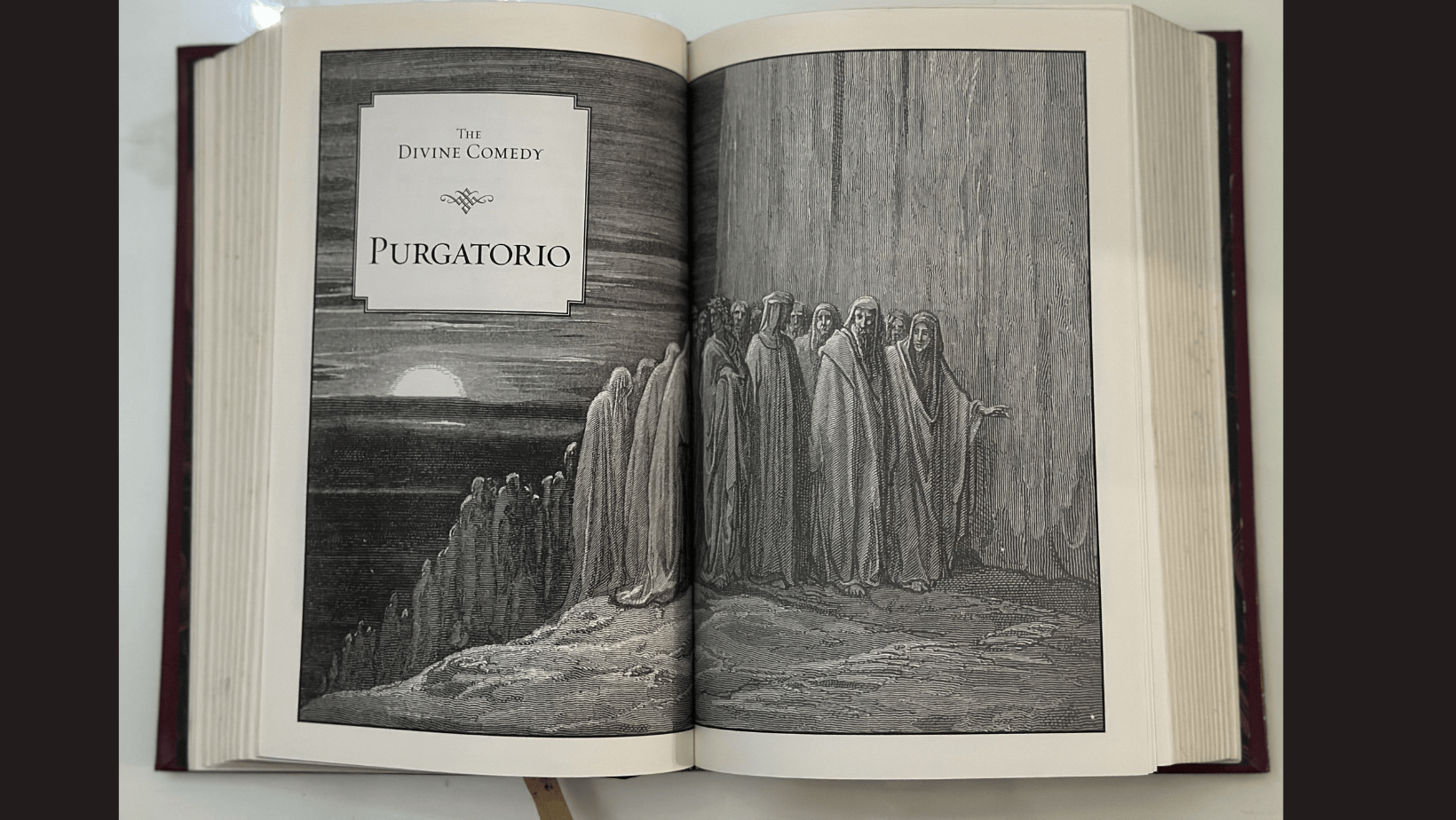
- Purgatorio (Purgatory) – 33 Cantos: Escaping Hell, Dante and Virgil arrive at the mountain of Purgatory. Here, souls endure temporary suffering to cleanse themselves of their flaws before they can enter Heaven.
Break it Up into Manageable Chunks
We often think of The Divine Comedy as three books, but Dante wrote it as one long poem divided into three parts—Inferno, Purgatorio, and Paradiso—which can be broken up even further into canti (singular: canto). Even though it may seem like a good idea to tackle the entire poem at once, it is best to take it one section at a time. Start with Inferno and read each canto until you reach the end of the section; then move on to Purgatorio and follow the same approach. Doing this will give you time to digest what you have read and understand its meaning before moving on to another part of the poem.


Themes and Historical Significance
The Divine Comedy explores timeless themes of divine justice, free will, and the soul’s journey toward enlightenment. Dante brilliantly blended classical mythology with Christian theology, creating a comprehensive vision of the medieval universe.
Historically, the poem transformed European literature. Instead of writing in traditional Latin, which only scholars could read, Dante wrote in his local Tuscan dialect. This bold choice made his work accessible to everyday people and essentially laid the foundation for the modern Italian language.
Why It Can Be Hard to Read
(And How to Overcome It)
Many modern readers struggle with The Divine Comedy. The text is dense, heavily layered with 14th-century Italian politics, obscure theological debates, and references to people you have probably never heard of. Dante populated his afterlife with his actual friends, political enemies, and historical figures.
If you want to tackle this masterpiece, you can easily overcome these hurdles with a few simple strategies:
- Pick the right translation: A modern, accessible translation makes a massive difference. Many readers recommend versions by Mark Musa, John Ciardi, or Robin Kirkpatrick for their balance of poetic flow and clear language. Mine was translated by Henry Wadsworth Longfellow.
- Embrace the footnotes: You do not need a degree in medieval history, but you do need a version with good notes. Read the summary before each canto to ground yourself in the action.
- Do not get bogged down: If a specific political rant or philosophical tangent confuses you, keep moving forward. Focus on the core narrative of Dante’s personal journey.
- Take it slow: Read one canto at a time. The poem is a marathon, not a sprint.

Research While You Read
Researching different aspects of the poem while you’re reading can help deepen your understanding of its contents. While researching can be quite intimidating due to the sheer amount of information available on Dante’s work, it doesn’t have to be overwhelming if done right. Focus on specific questions or topics while reading that may pertain to characters or events in the poem; this allows you to gain greater insight into each part without becoming too bogged down by minutiae or details that are irrelevant to your understanding of the text itself. Searching for scholarly articles or books related to Dante’s work may also prove helpful in better grasping its nuances.


Make Use Of Study Guides
While research can definitely help in understanding certain elements of a text, relying solely on scholarship isn’t enough when interpreting complex scenarios in a work such as The Divine Comedy. Googling Dante while reading helps a lot. There are universities with Dante Project websites (though they are intended for scholarly resources) that serve as your study guides. Other study guides provide comprehensive overviews, offering readers background information on various portions of the epic poem, which can help break down tough passages or decipher difficult characters or settings within its pages. These study guides also offer insight into stories from other works that appear within The Divine Comedy, as well as providing useful summaries for those who are short on time but still want to get a general sense of what happens throughout all three sections of Dante’s masterpiece. These ensure that you (readers) remain engaged throughout your journey throughout each canto and ultimately provide you with a greater appreciation for this classic work.
The key to reading Dante’s work: follow your own pacing. Do not rush, this masterpiece is meant to be enjoyed. There are times I leave the pages, just stare at the illustrations, or go to to the internet and check some background on specific canto. It helps a lot too that I read the life of Dante, his beloved Beatrice Portinari––these help me a great deal in understanding his work. Reading Dante’s Divine Comedy doesn’t have to be an intimidating experience, just take your time and enjoy it.

Justine Castellon is a brand strategist with an innate ability to weave compelling narratives. She seamlessly blends her professional insight with her passion for literature. Her literary works include romantic drama novels—Four Seasons, The Last Snowfall, Gnight Sara / ‘Night Heck, and I Love You, Sunday Sunset. With her ability to tell stories that linger long after the last word, Justine leaves a mark not only in the world of branding but also in the hearts of her readers.
www.justcastellon.com


Great advice, especially the point about taking your time, and enjoying it! There’s also an old saying that once you’ve finished reading the whole Divine Comedy for the first time, that’s when you’re ready to start reading the Divine Comedy 🙂