

Adaptations are a tough nut to crack, and Where the Crawdads Sing, based on Delia Owens’ best-selling novel, dives into the challenge with a mix of poignant moments and missed opportunities. Directed by Olivia Newman, the film stays largely faithful to the source material in terms of plot but struggles to capture the intricate, haunting atmosphere of the book, particularly its significant themes of isolation and resilience. While the cast, led by Daisy Edgar-Jones, gives commendable performances, the screenplay and pacing leave much to be desired for fans of Owens’ richly layered world.
Plot
Set against the marshlands of North Carolina in the late 1960s, the film introduces Kya Clark (Daisy Edgar-Jones), a young woman who has lived an isolated life in the wilderness after being abandoned by her family. Dubbed the “Marsh Girl” by the townsfolk, Kya has grown up self-sufficient, finding solace in the natural world while carefully avoiding the judgment and cruelty of the nearby community.
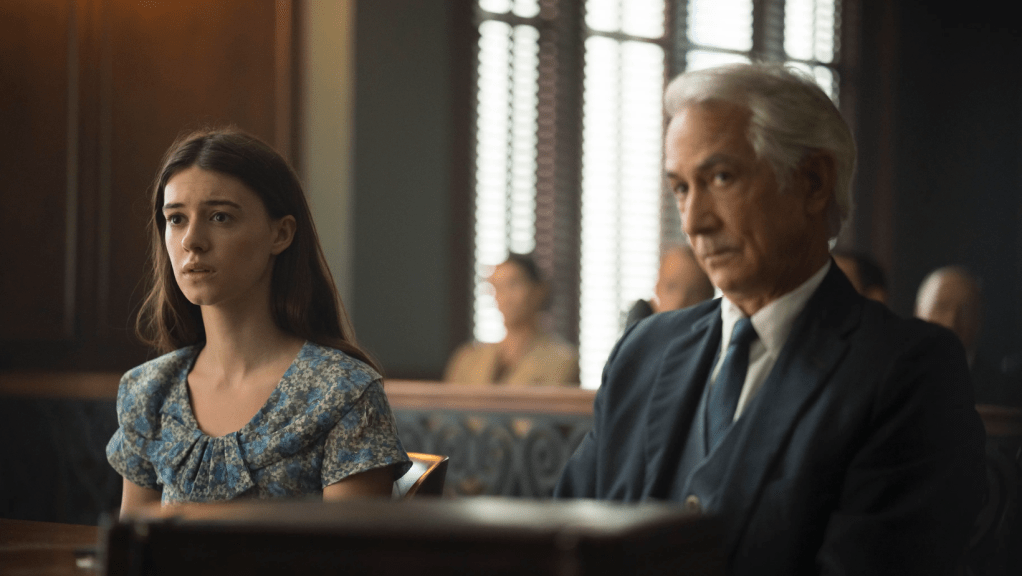
The narrative shifts seamlessly between Kya’s childhood—marked by abuse, abandonment, and survival—and her adult years, where she becomes the prime suspect in the murder of Chase Andrews (Harris Dickinson), a privileged local charmer with whom she once had a tumultuous relationship. The plot revolves around the trial as Kya’s lawyer, Tom Milton (David Strathairn), defends her, unearthing stories of her resilience, her connection with the natural world, and her fraught relationships with Tate Walker (Taylor John Smith), her first love, and Chase, the victim.
The film’s central question—did Kya kill Chase in self-defense, or was she unfairly scapegoated by the town?—unfolds alongside lush visuals of waterways, sunsets, and Kya’s profound bond with the marsh, which acts as both her sanctuary and her identity.
Screenplay and Dialogue
The screenplay, penned by Lucy Alibar, attempts to walk the fine line between staying true to Owens’ novel and condensing its sprawling narrative into a feature-length runtime. While the bones of the story remain intact, the adaptation leans heavily on melodrama, often at the expense of subtlety.
Alibar’s dialogue mirrors the poetic tone of Owens’ prose in places but feels a bit forced when pulled straight from the pages of the novel, especially during Kya’s inner monologues about nature and love. Lines like “The marsh knows how to keep secrets” sound impactful on paper but come off overly sentimental when spoken aloud. This disconnect, combined with rushed transitions between past and present, hinders the emotional depth of some key scenes.
A significant departure from the book is the film’s increased emphasis on Kya’s love life, particularly her relationships with Tate and Chase. While romance is a prominent theme in the novel, the book takes more time to explore Kya’s growth and her survival in solitude, elements that are somewhat sidelined in the movie. The courtroom scenes, too, lack the tension and gravitas of the book’s climactic buildup, rushing to a twist ending that feels abrupt rather than earned.

On-Screen Chemistry and Performances
The saving grace of the film is undoubtedly its cast. Daisy Edgar-Jones delivers a powerful performance as Kya, capturing the vulnerability, strength, and quiet defiance of a woman shaped by both abandonment and resilience. Her portrayal of Kya’s reclusive nature is nuanced, particularly in scenes where her connection to the marsh feels like an unspoken character in its own right.
Taylor John Smith as Tate brings warmth and earnestness to the role, making his and Kya’s initial chemistry believable, although his character arc feels underdeveloped compared to the book. Harris Dickinson, on the other hand, nails the arrogance and menace of Chase, making him every bit the antagonist the story requires, even if his role in the love triangle is emphasized more than his symbolic clash with Kya’s independence.
David Strathairn as Tom Milton brings gravitas to the courtroom scenes, though his character, reminiscent of an Atticus Finch archetype, gets limited development. Similarly, supporting characters like Jumpin’ (Sterling Macer Jr.) and Mabel (Michael Hyatt), who act as surrogate parents to Kya, are underutilized, reducing their tender relationship with Kya to a few fleeting interactions.


The Book vs. The Screenplay
Where the book excels as an intimate exploration of loneliness, survival, and connection with nature, the film struggles to translate these themes effectively. Owens’ novel thrives on vivid descriptions of the marsh, Kya’s internal conflict, and her slow transformation into a fierce, independent woman. The film, constrained by time, condenses much of Kya’s growth into montages or fleeting moments, leaving little room to fully appreciate her evolution.
The theme of loneliness, central to the book, is somewhat diluted in the film. The novel’s detailed exploration of how Kya thrives in solitude—the marsh becoming her only companion—is overshadowed by the focus on her romantic entanglements. Furthermore, the nuanced depiction of Kya’s relationship with the marsh, teeming with metaphors about survival and identity, is reduced in favor of plot-driven storytelling.
One of the more polarizing changes is the portrayal of Chase. The book paints him as a more nuanced predator, while the film hastens to make him a clear-cut villain, which robs the story of some of its moral ambiguity. Similarly, the film downplays Kya’s scientific achievements and her love for the natural world, which are central to the book and integral to her character’s growth.

Final Thoughts
While Where the Crawdads Sing succeeds in bringing the lush, atmospheric setting of the marshlands to life, it struggles to encapsulate the depth of Delia Owens’ novel. The film sacrifices some of the book’s most compelling themes—loneliness, resilience, and the relationship between humans and nature—in favor of a more conventional romantic drama, which may disappoint fans of Owens’ intricate storytelling.
That said, Daisy Edgar-Jones’ magnetic performance and the film’s stunning cinematography make it a worthwhile watch. For those who cherished the book’s poetry and poignant insights, however, the movie might feel like a simplified rendition of a much richer tale. It’s a decent adaptation, but it doesn’t quite linger like the haunting call of the marsh.


Book Review:
WHERE THE CRAWDADS SING
It follows Kya Clark, a young woman living in isolation in the marshlands of North Carolina from 1952 to 1969. Through her story, we learn about her struggles with loneliness and abandonment while she learns how to survive alone in an isolated environment surrounded by nature. It’s an incredibly powerful story that will leave you feeling inspired and uplifted despite its sad themes.

Justine Castellon is a brand strategist with an innate ability to weave compelling narratives. She seamlessly blends her professional insight with her passion for literature. Her literary works include romantic drama novels—Four Seasons, The Last Snowfall, and Gnight Sara / ‘Night Heck. With her ability to tell stories that linger long after the last word, Justine leaves a mark not only in the world of branding but also in the hearts of her readers.


 Just Reading Nook