
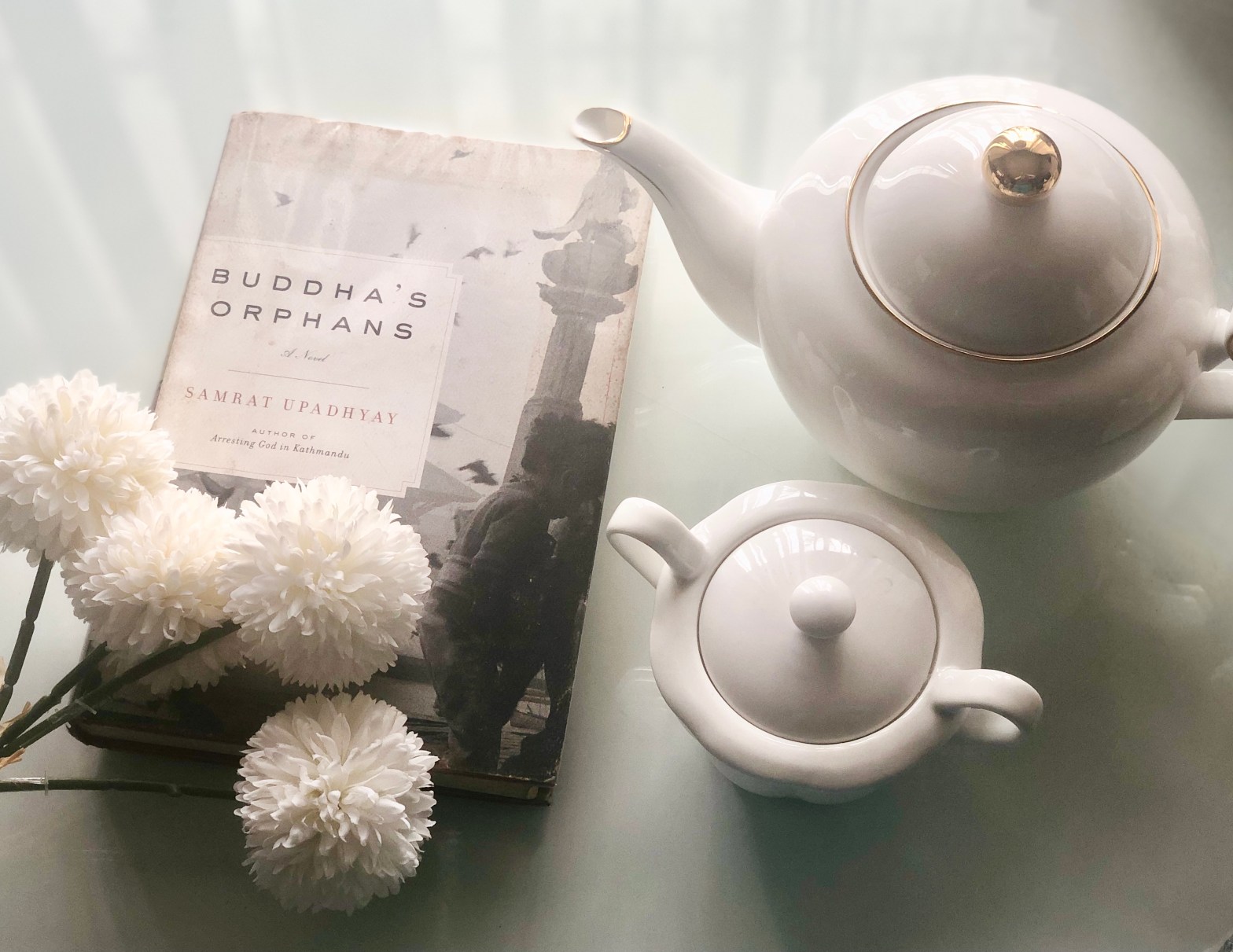
Buddha’s Orphans is a novel by Samrat Upadhyay, the story of two lovers Raja and Nilu set in Nepal during the 1960s until the near present. Raja had a struggling childhood while Nilu is child of privilege, but both orphans in spirit. They reunite in highschool, fall in love and eventually live together. Because of the country’s political disturbances, Raja has difficulties finding a job and often seen joining political rallies. After several challenges and hardships, a son was born. Unfortunately, the boy dies during his early school age because Nilu was unable to get him a medical treatment due to a political demonstration that clogs the road. While Raja is not present in that political demonstration, the couple have trouble dealing with their sons death and part ways After some time, they reunite and had a daughter Ranjani.
“While the bullet struck you, our king was probably sipping his wine and playing billiards and smoothing his mustache, and his wife was adjusting her bouffant hairdo for a party” –Raja
When their daughter went to study in America and suddenly stopped communicating with them, Raja and Nilu consider flying to Chicago. But Nilu decided to send her husband to America to search for their daughter while she, on a hunch, believes her daughter is somehow back in Kathmandu. After frantically searching the city, Nilu finds her daughter pregnant and about to give birth in Bahairavi’s. Nilu helps with the birthing of a baby girl Kali. Raja and Nilu raised their grandchild together with her daughter Ranjani.

Samrat Upadhyay’s Writing Style
One of the most striking aspects of Upadhyay’s writing is his deep emotional resonance. His prose feels effortless yet deliberate, blending vivid imagery with a calm, reflective tone that mirrors Buddhist philosophies of impermanence and interconnectedness. Upadhyay has a remarkable ability to root his characters in tangible experiences while connecting them to something vast and elemental, like the tides of Nepal’s history or the immutable nature of love.
Cultural nuance is woven seamlessly into the narrative. Upadhyay explores the rituals, landscapes, and daily rhythms of Nepal, making this a novel as much about place as about relationships. From the bustling streets of Kathmandu to the quiet inner sanctuaries of personal doubt and grief, the setting becomes a living, breathing character. Small, intimate details—a shared plate of momos, the fragrance of incense at a temple, or the quiet hum of political tension—immerse readers into a world that feels achingly real.
The novel’s non-linear structure mirrors the complexities of memory and emotion. Upadhyay moves fluidly between past, present, and future, inviting the reader to piece together the mosaic of Raja and Nilu’s lives. These shifts are never disorienting; instead, they reflect the cyclical nature of the characters’ search for meaning and resolution.
At its core, Upadhyay’s style is empathetic and deeply human. He writes with a tenderness that renders even the most flawed characters redeemable. The tone is neither overtly sentimental nor clinical; it finds a middle ground that feels honest and raw.
Why Buddha’s Orphans Captivates Readers
- Universal Themes in a Unique Setting
While the novel is firmly rooted in Nepal’s political and cultural tapestry, its themes are universal. The tension between love and duty, the search for identity, and the weight of ancestral and societal expectations resonate beyond geographical borders. Readers from any background can find reflections of their own experiences in Raja and Nilu’s struggles. - A Rich, Multi-Faceted Love Story
At its heart, Buddha’s Orphans is a love story, but it is far from conventional. Raja and Nilu’s relationship endures trials of class, abandonment, and personal trauma, evolving into something layered and enduring. Upadhyay treats romance not as an escapist fantasy but as a complex, dynamic phenomenon rooted in sacrifice, compromise, and shared resilience. - A Powerful Exploration of Identity
Raja’s identity as an orphan adds an enduring layer of vulnerability to his character. His relentless pursuit of belonging mirrors universal questions about where we come from and who we are. For readers, his quest becomes deeply personal, as it taps into the human desire for purpose and connection. - Socio-Political and Historical Layers
Another key strength of the novel is how it intertwines personal narratives with Nepal’s larger socio-political narrative. The setting is not just background—it shapes the characters’ lives in profound ways. For readers unfamiliar with Nepal, Buddha’s Orphans provides an intimate glimpse into the country’s struggles and transformations, from its monarchy to its political unrest. - Upadhyay’s Poetic and Reflective Voice
Upadhyay’s writing elevates the novel into the realm of literary art. His poetic descriptions, coupled with his ability to convey profound truths in simple moments, make Buddha’s Orphans a deeply satisfying read. For instance, a quiet memory of Nilu combing her hair carries as much weight as a politically charged town hall meeting, showing Upadhyay’s mastery of balancing the micro and macro aspects of his story.
Buddha’s Orphans offers a deeply immersive reading experience—one that lingers long after the last page. Its layered narrative explores love and loss in a way that feels human while embedding those personal stories within the rich socio-cultural fabric of Nepal. Samrat Upadhyay’s understated elegance as a writer ensures that readers not only connect with the characters but also reflect on their own relationships, hopes, and regrets.
For those who appreciate books that blend intimate character studies with richly textured settings, Buddha’s Orphans is a must-read. Its timeless themes, coupled with Upadhyay’s sensitive portrayal of Nepal and its people, make it a novel that appeals to both the heart and the intellect. At its core, this is a story about the resilience of love—and the human spirit—set against a backdrop that’s as intricate and enduring as the orphaned child at its center.
This is no ordinary tale. It’s an epic and an elegy, a love song and a lament—a celebration of survival amidst chaos and the enduring search for home. Also, reading Buddha’s Orphans is an immersion in Nepalese culture, political will and survival. It’s quite depressing at some point especially when you read about poverty. But since you’re already invested in the characters’ lives, you want to see what happens to them in the end. Samrat Upadhyay blends politics, history, poverty, tragedy and romance to create an interesting story about a family.

Justine Castellon is a brand strategist with an innate ability to weave compelling narratives. She seamlessly blends her professional insight with her passion for literature. Her literary works include romantic drama novels—Four Seasons, The Last Snowfall, and Gnight Sara / ‘Night Heck. With her ability to tell stories that linger long after the last word, Justine leaves a mark not only in the world of branding but also in the hearts of her readers.


 Just Reading Nook